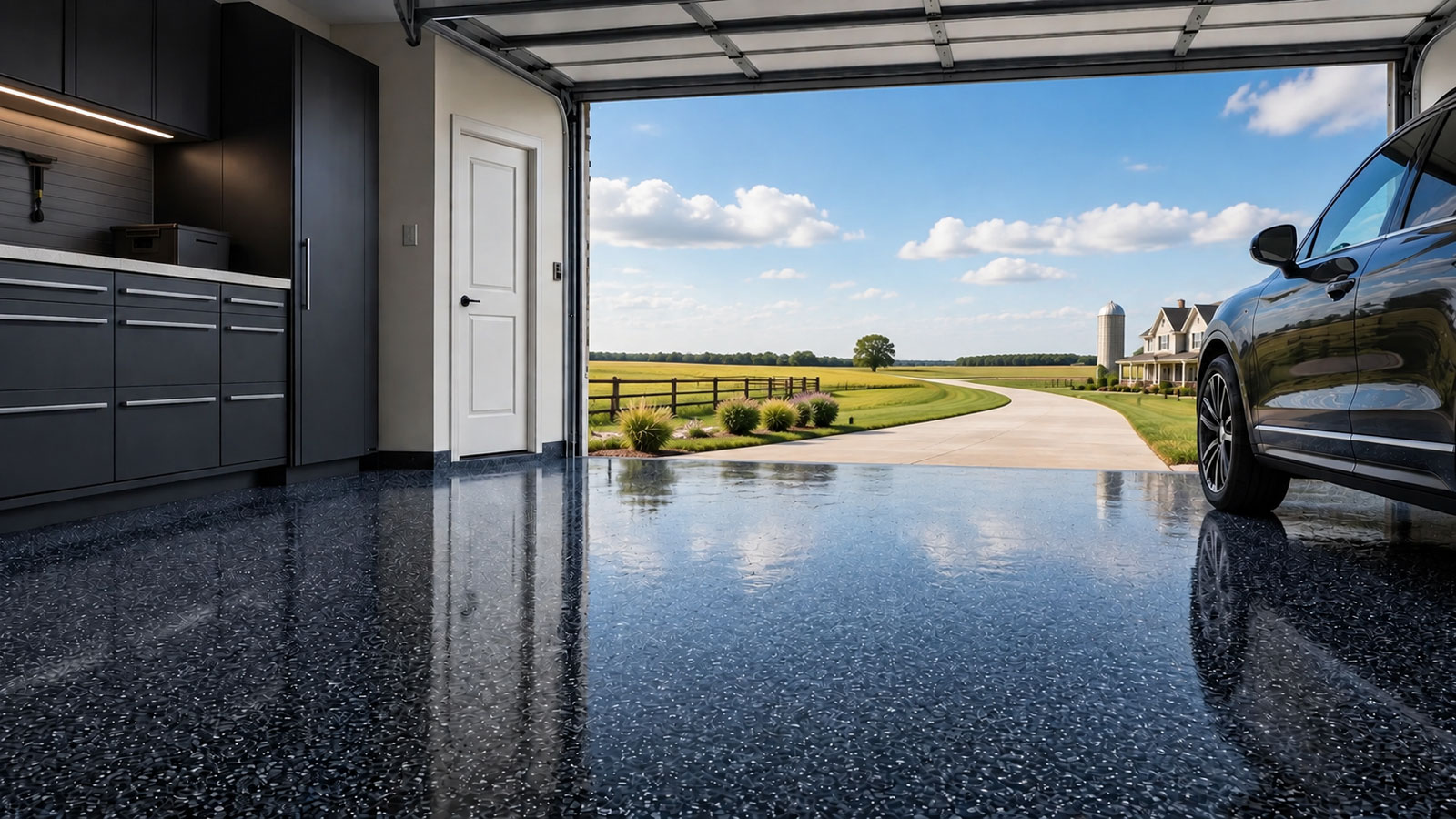
Garage Floor Coating in Jenks, OK
Floor Coating Services in Jenks, OK
Jenks was founded in 1905 as a railroad stop just as the Glenn Pool oil boom transformed the south Tulsa area. Its early growth was repeatedly interrupted by flooding: major 1922 and 1923 events covered most of town except the railroad tracks. Jenks therefore contains both older in-town garages with long repair or coating histories and newer attached garages with relatively young slabs. House age, neighborhood age and slab age may all differ when additions or repours have occurred.
A levee and later flood-control work changed that early pattern, while rapid suburban growth after 1980 added newer neighborhoods and larger attached garages. Flood protection changed the city's relationship with the river, so historic flooding should not be treated as a prediction of today's garage conditions. Polecat Creek and local drainage still make driveway grade, threshold runoff and actual dampness worth checking at the property.
Today, the Arkansas River, Polecat Creek, and smaller drainage systems still make water movement a local project variable. Older in-town slabs and newer south/west development can require very different preparation.
Local Market Insight
Jenks combines a 1905 oil-boom railroad town with documented early flood history and much newer suburban growth. Flood protection changed the city, but property-specific drainage still matters.
What Affects the Cost of Garage Floor Coating in Jenks?
Jenks projects can differ sharply between older in-town properties and post-1980 suburban growth. Old coatings, repairs and multiple pours may drive preparation on one floor, while sealers, curing products and builder patches dominate another. Arkansas River and Polecat Creek drainage, sloped lots, multi-bay layouts and cure-time requirements can further change the scope.
Older in-town surface history
Established garages can contain paint, repairs, old coatings, and concrete added later. Look for evidence of later garage additions and old coatings rather than assume the slab matches the home's age.
Newer subdivision slabs
Later growth created many younger floors with sealers, curing compounds, or builder residue. Ask how sealers, curing compounds or builder residue will be removed from young concrete.
Arkansas River and Polecat Creek drainage
Actual runoff and flood history should be checked at the property rather than assumed from location alone. Use observed runoff and water history at the lot, not river proximity alone, to define moisture-related work.
Driveway slope
Newer hillside and rolling-lot development can concentrate stormwater at the door. Check whether a sloped approach channels rain toward the garage or simply sheds it away.
Garage size and details
Multi-bay garages, stem walls, steps, and storage areas add edge work. Extra bays, stem walls and storage areas increase detailed grinding and coating edges.
Traction and finish
Wet-weather use, decorative flake, topcoat, and cure time influence the system. Balance traction and return-to-service timing with the way the family actually uses the garage.
Call for a clear, project-specific estimate — or request one online.
Local Garage-Floor Conditions in Jenks
Near older Jenks, identify paint, patches, old coating edges, and changes in concrete that may show later additions.
In newer development, identify sealers or curing compounds before assuming the slab needs minimal preparation.
If the property is near Polecat Creek, the Arkansas River, or a low drainage route, describe actual water behavior at the garage during heavy rain.
Jenks' early flood history is unusually specific
Floods in 1922 and 1923 covered most of early Jenks, with the railroad grade among the few areas above water. Later levees and flood-control measures changed that exposure.
That history is useful context, but the homeowner's current property is what matters. A dry garage behind modern protection is a different project from one with recurring threshold water.
Coating should follow current slab and drainage conditions rather than historic flood reputation alone.
The 1922 and 1923 floods reportedly covered nearly all of Jenks except the railroad tracks, and a levee funded after a 1948 bond vote was nearly overtopped again in 1957. That history explains why flood protection is part of the city’s physical story, but it should not be used to overstate a modern garage’s risk. A homeowner should instead identify actual threshold-water history, low grading, or slab-edge dampness and let those conditions drive the project discussion.
Post-1980 growth added a newer generation of garage slabs
Jenks expanded rapidly as the south Tulsa metro grew, creating large areas of newer residential development.
Those garages often shift the prep question from old paint toward curing compounds, sealers, builder patching, and control joints.
A younger slab still needs mechanical profiling before the coating system is installed.
Modern Jenks continues to manage drainage actively, including current work on the Wilmott Creek basin and Arkansas River bank stabilization. In newer subdivisions, the garage-floor issue is often not age-related deterioration but hidden surface treatments, control joints, and grading around recently developed lots. That makes a clean-looking slab a starting point for inspection, not proof that preparation will be minimal.
Current drainage work reinforces that this is still an active property issue rather than only a historic flood story. Jenks has been studying the Wilmott Creek basin and designing Arkansas River bank stabilization while newer development continues around the city. For a homeowner, that means checking modern subdivision grading and threshold runoff with the same care given to an older in-town property, even though the likely slab-preparation issues are different.
Before coating a Jenks garage
- Is the property in older Jenks or newer suburban development?
- Is the slab painted, sealed, or previously coated?
- Has water ever reached the garage?
- Is the property near Polecat Creek or the Arkansas River?
- Are cracks, joints, or patches visible?
- Does the driveway slope toward the door?
- How quickly must vehicles return?
Jenks Garage Floor Coating FAQs
Does Jenks' historic flooding mean every garage is high risk?
No. Modern flood protection and individual property elevation matter. The contractor should evaluate actual water history. In Jenks, actual driveway runoff and threshold history matter more than relying on the city's early flood story by itself.
Do newer Jenks slabs need grinding?
Yes. Mechanical preparation is still necessary even when the concrete is young and clean-looking. Newer Jenks subdivisions can still have sealers or curing products that must be removed before coating.
Can a coating fix water entering under the door?
No. Threshold or grading problems should be corrected separately. The floor finish should come after correcting any exterior grading or threshold condition that repeatedly admits water.
Is polyaspartic better for fast return to service?
It can cure faster than many epoxy systems, but slab condition, preparation, budget, and product requirements should all guide the choice. Fast return matters most when vehicle access is critical, but it should not replace proper concrete preparation.
How should Jenks homeowners interpret the city's early flood history today?
The 1920s floods are meaningful local history, but levees and later flood-control work changed conditions. Current garage decisions should rely on actual threshold water, driveway runoff, slab dampness and previous coating failure rather than assume historic flooding still defines every property.
Jenks Neighborhoods & Local Context
Phone Quote Line
Speak with a floor coating specialist about your project and get a realistic estimate range.
(918) 727-8827Typical Project Cost
$3,000–$5,500
Typical range for a two-car garage. Final pricing depends on floor size, concrete condition, prep work, coating type, and finish options.
Helpful Guides
Other Service Areas